Teddy's
Tony Machi's East Side club at 1434 N. Farwell Ave. booked Muddy Waters and Charles Mingus, went disco in 1975, added a mechanical bull and closed in 1985.
- Where
- 1434 N. Farwell Avenue, East Side, Milwaukee, Wisconsin
- Open
- 1973–1985
- Known for
- Blues and jazz room turned disco, then a country bar with a mechanical bull
- Reading time
- 4 minutes
From Capitol Records warehouse to The Barn on Farwell Avenue
The building at 1434 N. Farwell Ave., on Milwaukee's lower East Side, is really two buildings: a one-story, flat-roofed brick front with a concrete floor, joined to an older two-story gabled structure at the back that looks like a coach house. OnMilwaukee's Bobby Tanzilo, who went through the city permits in 2017, found the front in use as a public garage by the 1930s and known as the Farwell Avenue Garage in 1938.
In June 1947 offices were built across the front and the place became the Wisconsin branch of Capitol Records Distribution, which shipped the label's records to shops in the area into the 1960s. After Capitol left, a shop called the Record Farm opened in the front in October 1965. It did not last, and by late 1967 the space was being remodeled as a tavern.
Tony Machi opened it in 1968 as The Barn, with a wooden front built to look like one. The Wisconsin LGBTQ History Project describes the club as Machi's second act after Tony's Riviera, a downtown bar that ran until 1964 and that the project calls the most popular gay bar in the city in its day. The Barn had a fire in 1970, was repaired and reopened.
Muddy Waters, John Lee Hooker and Charles Mingus at Teddy's
By 1973 the club had a new name, Teddy's, after Machi's son Ted. A stage stood along the south wall of the bar, about halfway back in the main room, and it took both local and national acts. Performers used the attic of the old back building as their dressing room.
John Lee Hooker played there in the early days. Muddy Waters did runs of several nights at the club in 1973, and closed out 1974 with five nights in a row. Dave Van Ronk also appeared. In 1976, after the room had been made over for dancing, Charles Mingus brought his band to the same small stage; a photograph of that night by Kevin Lynch survives.
Radio Milwaukee, summing up the address in 2017, remembered Teddy's simply as a live music venue. The other sources remember it for what came next.
“I sort of knew we needed a place for live music. And this was a historic location.”
The $25,000 disco conversion of 1975
In 1975 Machi spent $25,000 to turn the club into a disco, a figure given both by the Shepherd Express historian Matthew J. Prigge and by the Wisconsin LGBTQ History Project. Prigge sets it beside the larger sums other Milwaukee clubs were spending in those years on lit dance floors and sound systems, as the city's rooms dropped live bands for records.
In October 1977 Teddy's began advertising in Milwaukee's gay press, promising a big-city disco on the level of Le Jardin in New York or Faces in Chicago. The club was about a block from the headquarters of the Gay People's Union, and the History Project, which lists Teddy's among the city's historic gay-identified nightspots, records it as open and welcoming to a mixed crowd of men and women. It was also known as a singles bar, and the project notes that it appeared in national swingers' magazines. A Milwaukee Journal round-up of the city's discos on January 26, 1979, called Teddy's Discotheque a "well-established soul disco."
The sources do not agree on when disco arrived. The History Project's current page says the change from jazz club to disco came in 1972; its older archive page, the Shepherd Express and OnMilwaukee all give 1975.
The mechanical bull, punk bills and the 1985 closing
When disco faded, the club went back to live bands as Teddy's Nightclub. In 1980, after the film "Urban Cowboy", it went country-western and installed a mechanical bull, the thing Tanzilo calls the most memorable feature of the place. The bull's leather saddle was still in the attic when he visited in 2017, along with some stained glass panels.
Bands kept playing. The Milwaukee group the Haskels appeared at Teddy's, and by 1984 touring punk bands including Black Flag, Subhumans and TSOL were on its bills.
According to the History Project, Teddy's announced in April 1981 that it would be sold to a developer who planned to raze the building in 1984. The redevelopment never happened. Wisconsin raised its drinking age from 18 to 19 in 1984, with a rise to 21 plainly on the way, and Tanzilo writes that live music clubs suffered for it. The History Project gives July 31, 1985, as the last day of Teddy's.
The Funny Bone, then Shank Hall since 1989
A comedy club, the Funny Bone, took the room next. The History Project dates it from September 1985 to December 1988, and Peter Jest, who followed it, says it lasted until New Year's Eve 1988. Wikipedia's article on the building starts the Funny Bone a year earlier, in 1984.
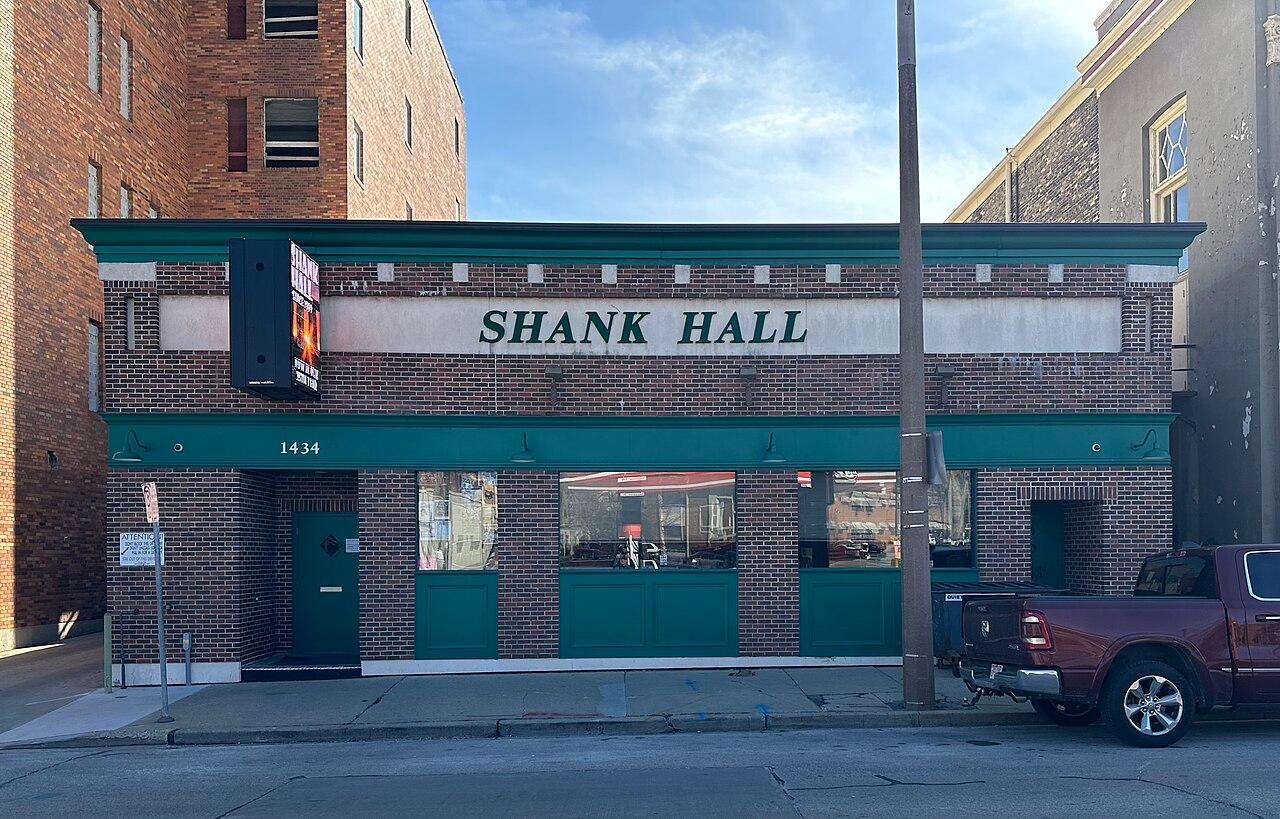
The building then sat empty for most of a year. By then it belonged to the owner of the office building next door, who was looking for a tenant. Jest, a concert promoter in his mid-twenties, rented it and opened Shank Hall in November 1989, naming it after the fictional Milwaukee club in the film "This Is Spinal Tap". The barn-style wooden front put up in 1968 lasted into the Shank Hall years.
Jest bought the building in 1999. After a fire he rebuilt the club with a new facade, took out a plexiglass wall that had separated the bar from the music room, and raised the capacity from 240 to 300. Shank Hall still presents live music at 1434 N. Farwell Ave.
Sources
- Urban spelunking: Shank Hall, OnMilwaukee
- Teddy's (places directory), Wisconsin LGBTQ History Project
- Teddy's (historical archive page), Wisconsin LGBTQ History Project
- Disco Inferno! A Brief History of Milwaukee's Discos, Shepherd Express
- Musical history inside Shank Hall, Radio Milwaukee
- Shank Hall on Milwaukee's east side celebrates 25th anniversary, FOX6 Milwaukee
- Shank Hall, Wikipedia
From the regulars
Were you there? Be the first to add a memory of Teddy's.
Share a memory of Teddy's
The gift shop
The Teddy's sign on a tee, hoodie and more, each printed to order. All Teddy's pieces