Park Avenue
Park Avenue, "Thee Nightclub", filled two floors of the Button Block at 500 N. Water Street with light towers and dancers from 1978 to New Year's Day 1989.
- Where
- 500 N. Water Street at Clybourn Street, Button Block, downtown Milwaukee
- Open
- 1978–1989
- Known for
- Two-storey downtown disco with light towers that dropped over the dance floor
- Reading time
- 4 minutes
Opening in the Button Block in November 1978
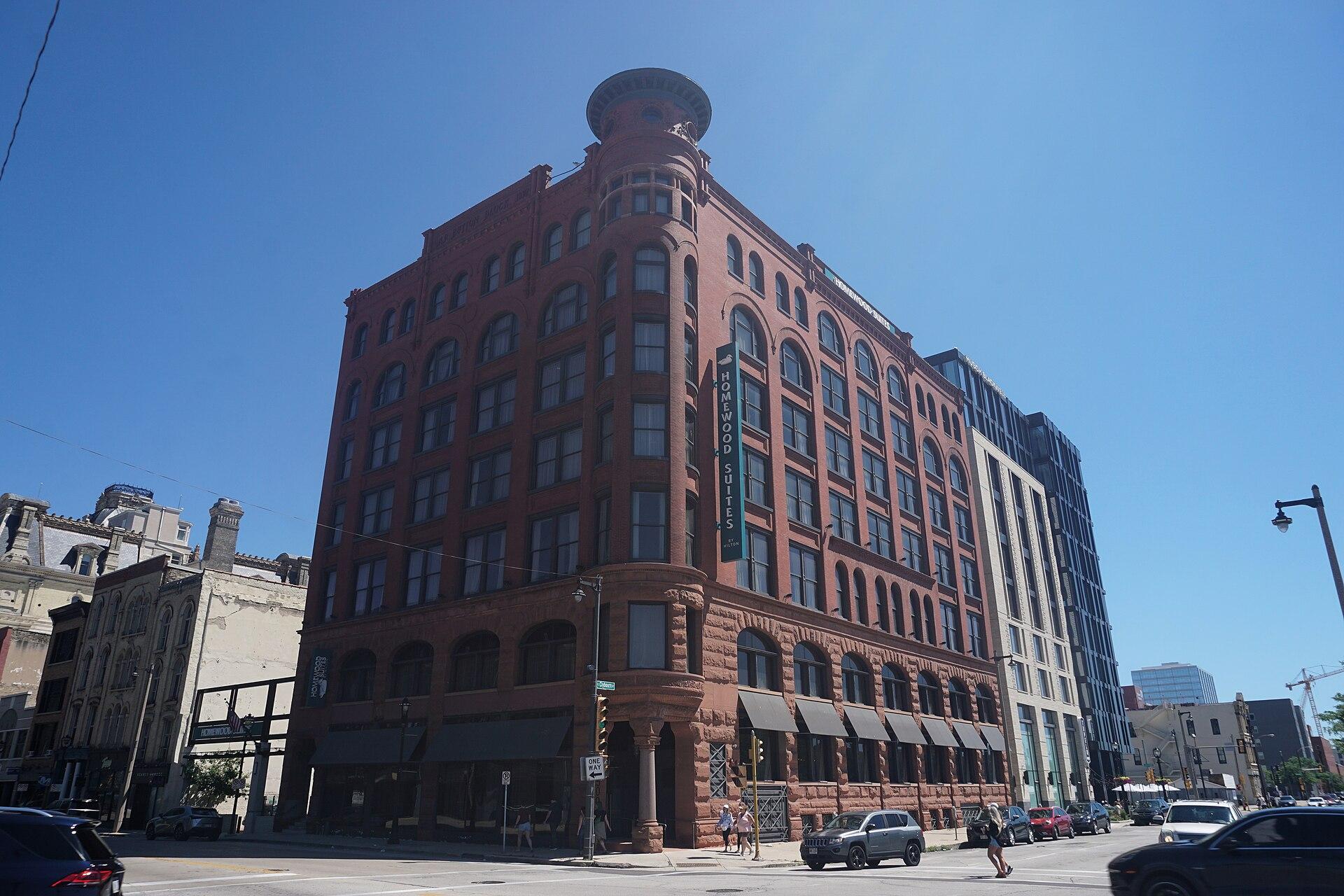
Park Avenue opened on November 23, 1978, at 500 N. Water Street, on the corner of Clybourn Street in downtown Milwaukee. The date comes from the Wisconsin LGBTQ History Project, which has kept the fullest record of the club. Its home was the Button Block, a seven-storey red sandstone building finished in 1892 to a design by the architects Crane and Barkhausen, with a round turret over the corner entrance. The club took the two lowest floors, which had been a bar called the Mad Hatter.
It arrived a year after Saturday Night Fever had pushed disco into the Milwaukee mainstream, and it aimed higher than the rooms that came before. The Shepherd Express, drawing on the Milwaukee Journal's report of the opening, calls it the city's most posh and exclusive disco up to that time. City officials, media figures and local models were on the opening night guest list. Park Avenue ran as a private club with annual dues, a strict dress code and a code of conduct for guests, and it sold itself as a New York style nightclub. Its matchbooks read "Park Avenue, Thee Nightclub" under a tree drawn inside a circle.
The dance floor, the balcony and the light towers
The dance floor sat in the middle of the building and the space above it was open through two storeys. The main bar ran the length of the south wall. Upstairs, a balcony with railings ringed the floor so that people could watch the dancers below, and there were more bars and quieter corners, including a windowed alcove inside the turret above the door.
The History Project remembers the light show as the best in town for a time. Towers of flashing lights stood at the corners of the floor and could be lowered from the ceiling to the floor and raised again through the night, with dancers keeping out of the way. There were feather drops and blender drinks. The novelist Paul McComas, a Milwaukee native, put the club in his book Planet of the Dates and described a translucent floor lit from underneath in a coloured grid, under a very large mirror ball.
“There were nights when we would literally have hundreds of people standing in line, waiting to get in.”
"Sundays", the gay night, and the arguments about the door
Six nights a week the crowd was mostly straight. On Sunday the club took the name Sundays and catered to gay patrons, with invitation or membership cards required at the door and themed parties advertised from the summer of 1979. The night was popular, and it was resented. Owners of full-time gay bars objected to a club that competed with them one night in seven, and pressed gay publications to refuse its advertising. The History Project says the dispute was part of the reason Gay Milwaukee magazine stopped publishing; its last Sundays advertisement ran in May 1981.
Mad Hatter Night, the box and the barber chair: the 1980s
Disco faded and Park Avenue kept going as a dance club with video screens, fog machines and a full week of promotions. Jim Lombardo, who ran the club's marketing, told OnMilwaukee's Drew Olson in 2008 that Ladies' Night began on Tuesdays and moved to Fridays, that Tuesday to Thursday were Mad Hatter Nights, and that Saturdays alternated between Sudden Saturday, with 50-cent cocktails for two hours from 6 p.m., and Champagne Saturday. New Year's Eve sold out in advance at about $75 a head.
Readers who wrote to Olson remembered 32-ounce beers in wax cups, large boxes on the dance floor that people climbed to be seen from the balcony, a barber chair in the corner for upside-down shots, and a Thursday alternative night. One recalled a Monday college night in 1982 hosted by the WQFM radio personalities Rodio and Mueller. Sailors on leave from the Great Lakes base in Illinois were regulars, and Olson wrote that Brewers, Bucks and Packers players came in too.
The last party on New Year's Day 1989 and what came after
By the late 1980s the club's best years were behind it, in the History Project's words. Park Avenue held a final party and closed on New Year's Day 1989.
The room reopened as Bermuda's, a few months later by one History Project account and in 1990 by another, without a gay night. Bermuda's booked touring bands for a short time, among them Book of Love, That Petrol Emotion and Voice of the Beehive. Two brothers from Chicago then rebuilt the space as a three-level club called Nitro. On September 29, 1992, with that renovation nearly done, a four-alarm fire started on the sixth floor and badly damaged the top three storeys. The timber frame held, and Nitro opened that November. The History Project's pages give its closing variously as 1995 and early 1996.
Brett Favre's Steakhouse took the two lower floors in 1997 and Joey Buona's replaced it in 2001. The upper floors stayed empty until Bear Development of Kenosha converted the whole building into a 94-room Homewood Suites hotel at a cost of about $17 million. It took its first guests on November 21, 2017. The Button Block is on the National Register of Historic Places.
Sources
- Park Avenue, a.k.a. Sundays, Wisconsin LGBTQ History Project (archive)
- Park Avenue (aka Sundays): Image Gallery, Wisconsin LGBTQ History Project (archive)
- Park Avenue, Wisconsin LGBTQ History Project
- Nitro, Wisconsin LGBTQ History Project
- Disco Inferno: A Brief History of Milwaukee's Discos, Shepherd Express
- Park Avenue: Hazy memories of the crazy 1980s, OnMilwaukee
- Urban spelunking: Building a hotel in the old Joey Buona's (Button Block), OnMilwaukee
- Downtown Milwaukee's newest hotel is open for business, BizTimes Milwaukee
- Park Avenue matchbook, More Milwaukee Memories page 8, Retro Milwaukee
From the regulars
Were you there? Be the first to add a memory of Park Avenue.
Share a memory of Park Avenue
The gift shop
The Park Avenue sign on a tee, hoodie and more, each printed to order. All Park Avenue pieces