Latin Quarter
Lou Walters opened the Latin Quarter on West 48th Street in 1942: three revues a night, showgirls, Sinatra and Mae West, until it was padlocked in 1969.
- Where
- 200 West 48th Street, between Broadway and Seventh Avenue, Times Square, New York
- Open
- 1942–1969
- Known for
- Times Square showgirl revue nightclub
- Reading time
- 3 minutes

The building on West 48th Street before 1942
The Latin Quarter occupied an odd, trapezoid-shaped lot at 200 West 48th Street, wedged between Broadway and Seventh Avenue. The building had already been through several lives. It opened around 1900 as the Palais Royal, a theatre and concert hall, then housed a Broadway branch of Harlem's Connie's Inn, a Chinese restaurant and George White's Gay White Way club. In 1935 it became the Club Ubangi, and from 1936 to 1940 it was the downtown home of the Cotton Club after that club left Harlem.
Lou Walters opens the Latin Quarter in 1942
Lou Walters, a booking agent who had started out in Boston, opened his first nightclub under the Latin Quarter name in 1937 with the theatre owner E.M. Loew as his partner. He put all his savings into it and, by the usual telling, had 63 cents left on opening night. The chain grew to clubs in Boston, Miami Beach and Detroit, and in 1942 Walters took over the old Cotton Club space on 48th Street and reopened it as the New York Latin Quarter, with Walters as manager and part owner and Loew's money behind him.
The room seated about 600, and its name and decor borrowed from Paris and French New Orleans. It took in more than $1.5 million in its first year, and over 5 million people passed through in its first decade.
Three shows a night: showgirls, comics and headliners
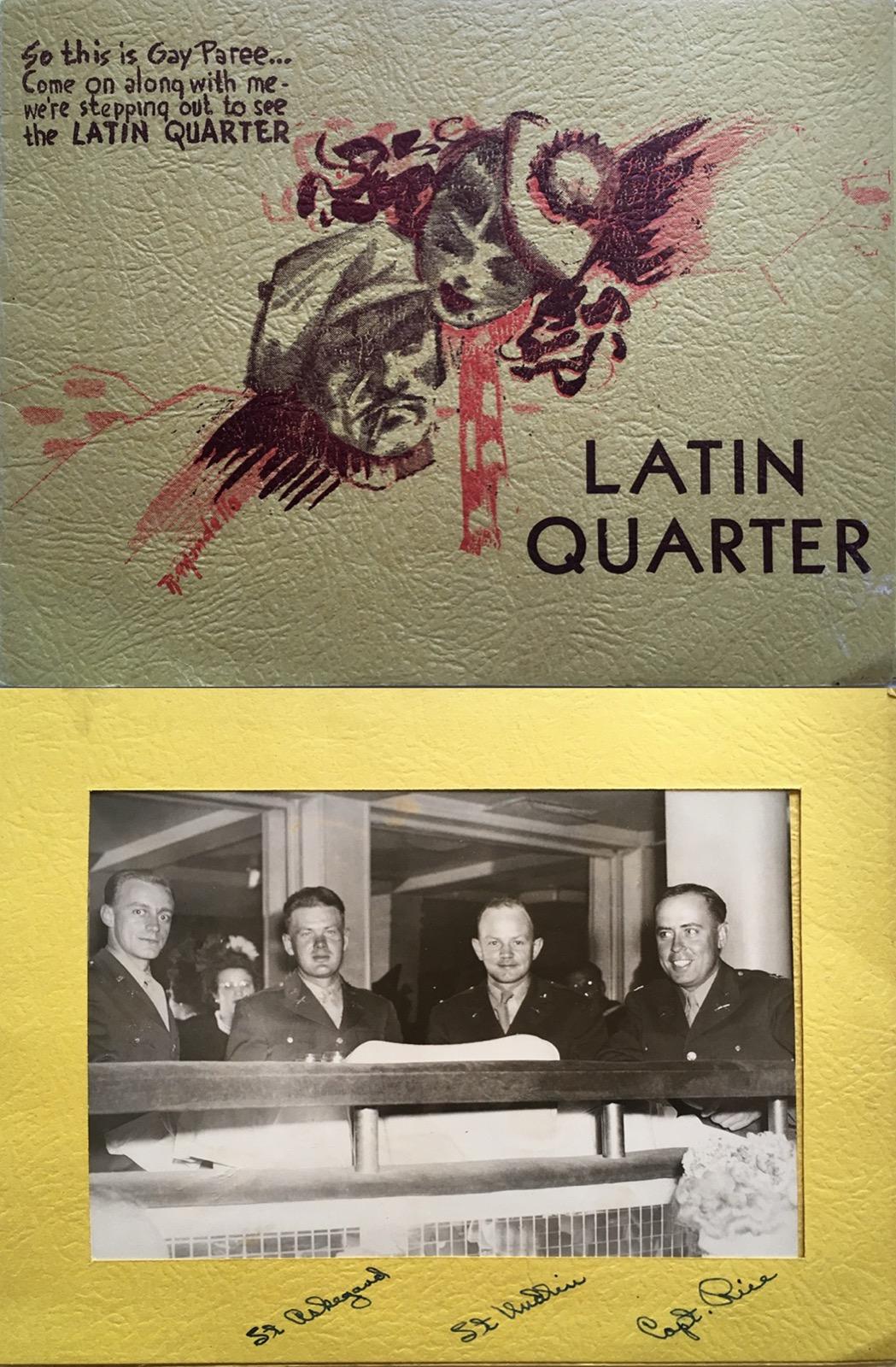
The Latin Quarter ran three shows an evening. Walters held auditions for chorus girls in London, Paris and the big American cities, and dressed them in costumes from leading designers, among them Erté. The finale was a can-can. Headliners over the years included Frank Sinatra, Ella Fitzgerald, Mae West, Milton Berle, Sophie Tucker, Patti Page, the Andrews Sisters, Frankie Laine, Ted Lewis and Mickey Rooney.
In November 1949 LIFE sent the photographer George Silk to cover the club as an example of the city's showgirl revues. His pictures caught the comic Frank Libuse posing as a waiter, squirting water at diners and brushing them with a potted palm, and the singer Ernestine Mercer working through Cole Porter songs.
Much of the audience came from out of town. Travel agents, convention organisers and insurance companies booked tables in bulk, and by 1956 some insurers were handing out a night at the Latin Quarter as a prize to their best salesmen. In the 1940s and 1950s New Year's Eve tables had to be reserved by July or August. The most-ordered dinner in the mid-1950s was roast beef.
Walters sells out and the club is padlocked
Walters sold his share of the Latin Quarter chain to Loew in 1956 for $500,000 and put the money into a new venture, the Cafe de Paris, which failed in both Miami and New York and left him deep in debt. In 1965 he came back to run the Latin Quarter chain as a salaried manager, and he retired in 1967. Under its new management the 48th Street club was, according to the columnist Earl Wilson in 1964, more expensive than the Copacabana.
The end came at the close of the 1960s. Cinema Treasures records a strike by the Latin Quarter chorus girls in July 1969, and Wikipedia's account says the club was padlocked that year over unpaid rent while the dancers were out. The food-history blog Restaurant-ing Through History dates the closing slightly earlier, to just before New Year's Eve 1968.
Cine Lido, hip-hop and Lou Walters Way
The upstairs supper room was remodelled into the 575-seat Cine Lido, which opened with Radley Metzger's Camille 2000 and showed adult films until 1978. The space then became the 22 Steps disco, the 22 Steps and Princess theatres, and from 1984 briefly took back the Latin Quarter name for stage shows. In the later 1980s it was a hip-hop club under that name, name-checked in records by Boogie Down Productions, Ice-T and Public Enemy, and it had a violent reputation: three people were shot leaving a Roxanne Shante show in 1987.
The building was demolished in 1989 and replaced by a 22-storey Ramada Renaissance hotel. Lou Walters, father of the broadcaster Barbara Walters, died in Miami in 1977. In 2006 the city gave the block of 48th Street between Broadway and Seventh Avenue the honorary name Lou Walters Way.
Sources
- Latin Quarter (nightclub), Wikipedia
- Lou Walters, Wikipedia
- Cine Lido, Cinema Treasures
- New Year's Eve at the Latin Quarter, Restaurant-ing Through History
- Wild Manhattan Nights: A Peek Inside the Latin Quarter, 1949, LIFE
The gift shop
The Latin Quarter sign on a tee, hoodie and more, each printed to order. All Latin Quarter pieces