Cocoanut Grove
The palm-tree nightclub in the Ambassador Hotel on Wilshire Boulevard hosted Oscar nights, coast-to-coast band broadcasts and Sinatra, from 1921 until 1989.
- Where
- Ambassador Hotel, 3400 Wilshire Boulevard, Los Angeles, California
- Open
- 1921–1989
- Known for
- Hollywood nightclub under fake palm trees
- Reading time
- 3 minutes
Opening in the Ambassador Hotel in 1921
The Ambassador Hotel opened on January 1, 1921, on 24 acres of Wilshire Boulevard, which was then little more than a dirt road. Myron Hunt designed it. Its first nightclub was the Zinnia Grill, with murals painted on black satin, but demand for evening entertainment was high enough that the management turned the hotel's main ballroom into a new club. The Cocoanut Grove opened there on April 21, 1921. It seated about 1,000 people in tiers, and boxes were rented by the year.
The hotel sat close to Hancock Park, whose wealthy families used the Grove for dinners and debutante balls, and its bungalows drew New York actors who had come west to make films. The hotel's publicity director, Margaret Tante Burk, credited the room with bringing society and show business together.
Papier-mâché palms and mechanical monkeys
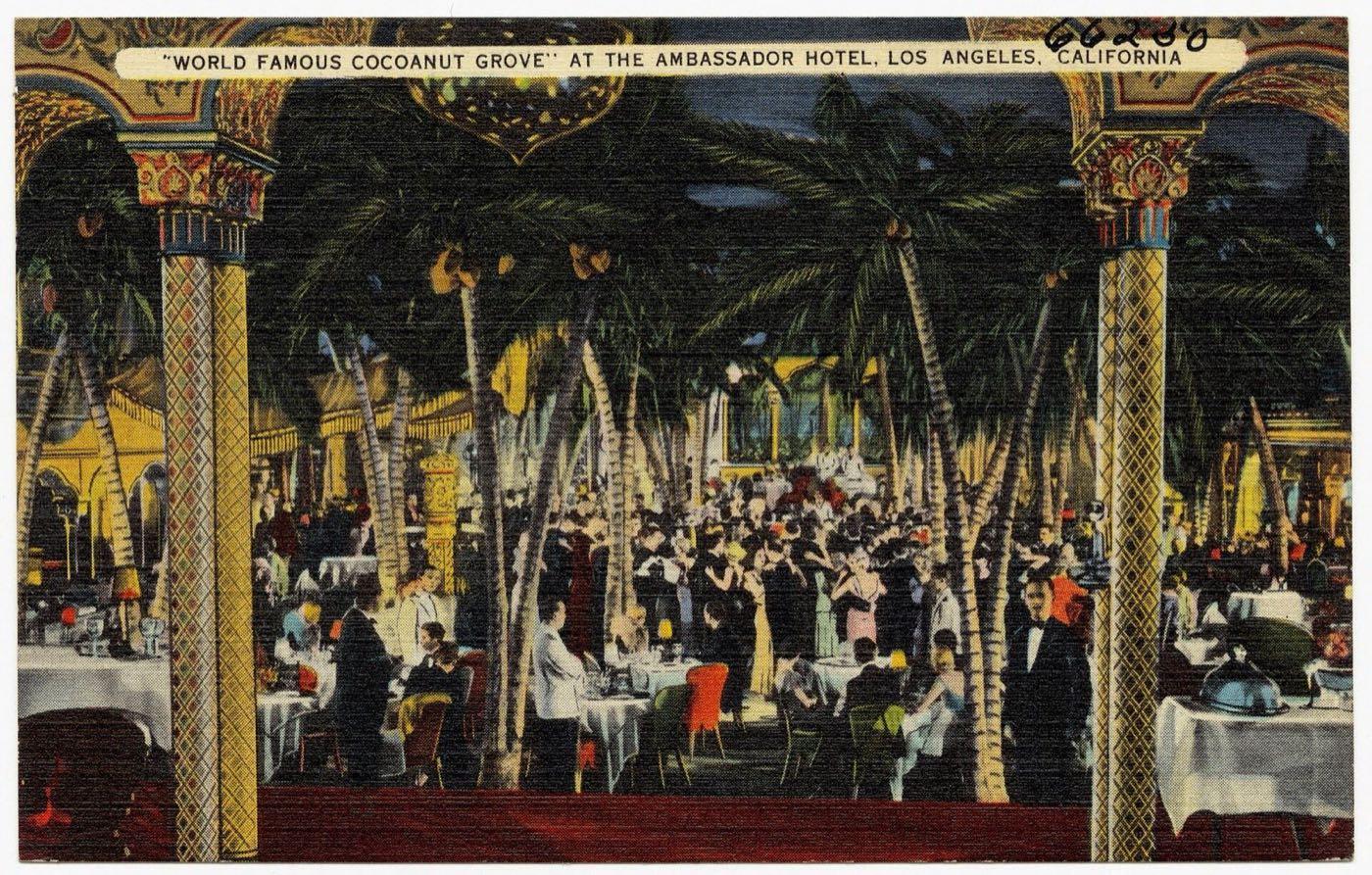
The decor borrowed from everywhere. Guests came in through gold-leafed doors engraved with palm trees, under Moorish arches, into a room with a tropical mural, an illuminated moon and a running waterfall. Chinese lanterns hung between papier-mâché coconut palms said to have been salvaged from the set of Rudolph Valentino's film The Sheik, and stars glittered in the ceiling. Life-size mechanical monkeys with glowing amber eyes sat in the trees, and a monkey in a top hat became the club's emblem. A story goes that John Barrymore's pet monkey climbed one of the palms in 1932 to inspect them.
“Because it was practically a guarantee that we could do film work during the day then have the great exposure of the coast-to-coast broadcast in the evening.”
Oscar nights, dance contests and radio broadcasts
Through the 1920s and 1930s the Grove was where Hollywood went out. Florenz Ziegfeld produced a night frolic there in 1922. Joan Crawford and Gloria Swanson competed in its dance contests, with Charlie Chaplin, Jesse Lasky and Louis B. Mayer among the judges. Cameras were not allowed in unless invited, which helped stars relax. Marion Davies rode a white horse through the hotel lobby on her way to a costume party in the Grove. The Academy Awards were held in the club five times, starting in 1930; the Los Angeles Conservancy counts six Oscar ceremonies at the hotel in all.
Bandleaders were broadcast live from the room across the country, which made it a prize booking. Bing Crosby was discovered there singing with the Rhythm Boys. Scenes from both the 1937 and 1954 versions of A Star Is Born were shot in the club. During the Second World War the bands of Harry James, Horace Heidt and Carmen Cavallaro played to crowds that included servicemen on leave.
Sinatra, Garland and the Now Grove
The room was remodelled in 1939 and again in 1957 and kept booking big names: Frank Sinatra, Lena Horne, Nat King Cole, Peggy Lee, Bobby Darin and Johnny Mathis. It was the first major club to hire Harry Belafonte. Judy Garland recorded her live album Garland at the Grove there in 1958, and Barbra Streisand was cast in Funny Girl soon after a three-week run in the room. In the 1960s acts such as Ray Charles, the Supremes and Liza Minnelli played between the dance bands.
By 1970 nightclub business was falling, and the hotel decided to rebuild the Grove as a Las Vegas-style showroom. Sammy Davis Jr. advised on the new room and threw a wrecking party on February 24, 1970, inviting guests to smash the old decor. The Now Grove, done in black, silver, purple, orange and pink, booked Aretha Franklin, Tony Bennett, Sonny and Cher and other headliners, but its costs outran its takings and it shut in 1972. Under new management it reopened as the Cocoanut Grove on October 31, 1972, with smaller acts such as the Four Tops.
How the Cocoanut Grove closed and what replaced it
As tastes changed and the area around the hotel suffered from gang and drug problems, the Grove sat dark through much of the 1970s and 1980s, used for private parties, conventions and film shoots. The Ambassador closed in 1989, taking the club with it, though the empty room stayed in demand as a film location.
The Los Angeles Unified School District bought the property in 2001 to build schools. The Los Angeles Conservancy and other groups sued to save the hotel, and a 2004 settlement committed the district to keep and reuse the Cocoanut Grove among other parts. Demolition began in October 2005. In October 2007 the Conservancy sued again, saying the district had broken its promises, and a January 2008 settlement added $4 million to a fund for historic school buildings. According to the Conservancy, only the porte-cochère and one wall of the Grove were kept, and the rest is a replica. The site is now the Robert F. Kennedy Community Schools, whose first school opened in September 2009.
Sources
- Cocoanut Grove (Ambassador Hotel), Wikipedia
- Ambassador Hotel (demolished), Los Angeles Conservancy
- Former Ambassador Hotel site houses schools, art and a park, Landscape Architect and Specifier News
The gift shop
The Cocoanut Grove sign on a tee, hoodie and more, each printed to order. All Cocoanut Grove pieces