Busch's Grove
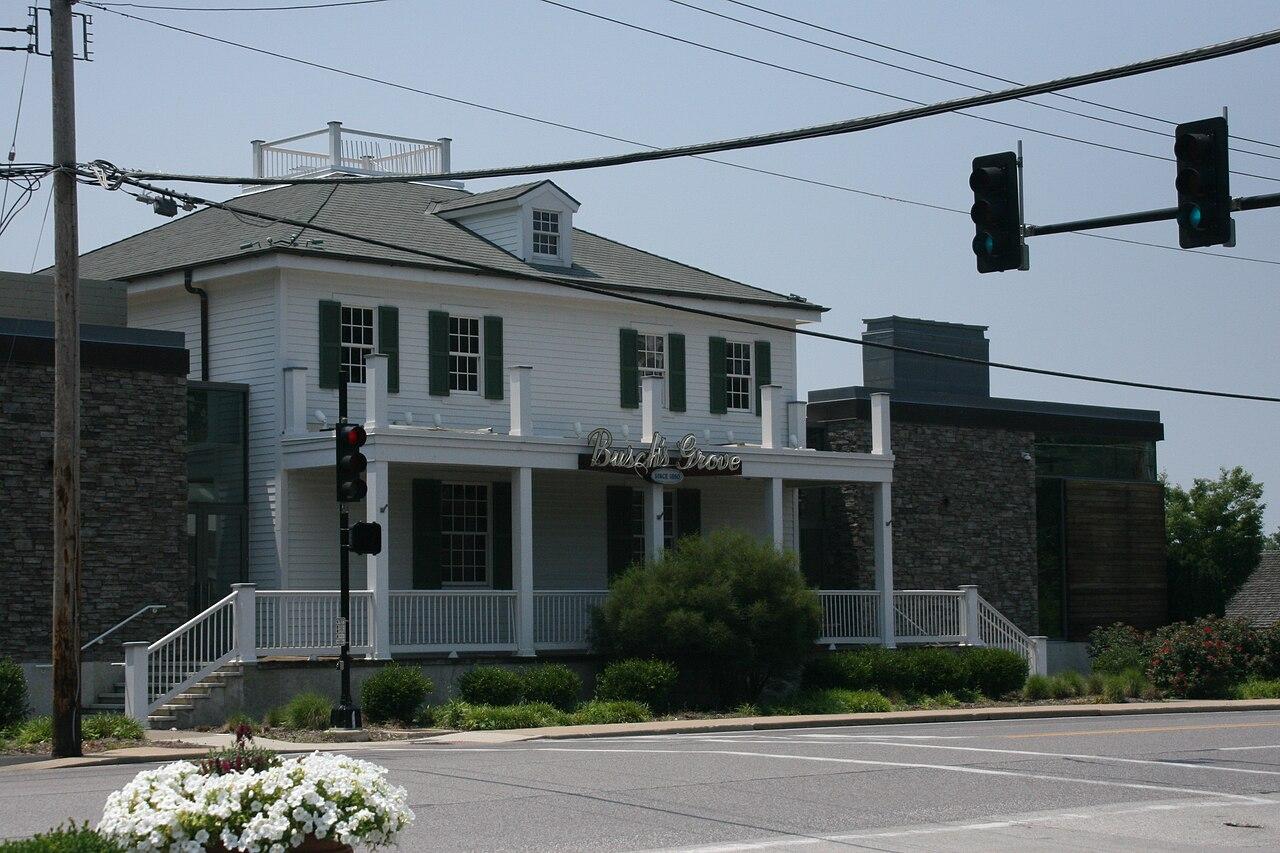
A white frame roadhouse at Clayton and Price roads in Ladue, with screened log cabins, a men's bar and Russ's salad, run by two families from 1891 to 2003.
- Where
- 9160 Clayton Road at Price Road, Ladue, Missouri
- Open
- 1891–2008
- Known for
- Ladue roadhouse with screened log dining cabins and a men's bar
- Reading time
- 3 minutes

A stagecoach stop on Clayton Road
The corner of Clayton and Price roads, about ten miles west of downtown St. Louis, had a building on it long before it had a restaurant. John Philip Litzinger bought the land from James S. Forsyth in 1855 for $1,000 and sold it in 1869 for $6,000, a jump that suggests he had put up the first frame building, possibly a blacksmith's shop and stagecoach stop. Charles Robyn bought it in 1873 and ran it as a roadhouse and public garden called Woodland Grove, which also held the Price post office.
John Busch takes over in 1891
In March 1891 Robyn sold the property to the wholesale grocer George Buente, who leased it to John H. Busch. Busch had married in Amsterdam in 1869 and then emigrated to St. Louis. He became the Price postmaster in July 1891, and the post office stayed in the building. For a few years the papers used Woodland Grove and Busch's Grove interchangeably; a 1990 column by Michael and Jane Stern gave 1890 as the year he started. Because the place was so far out of the city, the menu printed the streetcar timetable.
In 1909 Busch's son Henry and his friend Paul Kammerer took over the running of it, and in 1916 they bought the 12.8 acres from the Buente estate for $26,000. In 1908 a dozen oysters cost 50 cents and a sirloin with onions a dollar. Visiting prizefighters trained there, and during the 1904 World's Fair it threw parties for the Irish tenor John McCormack.
“Anybody who can find their way across the ocean to Paris can surely find the men's restroom.”
The log cabins and the men's bar
Behind the house stood screened log cabins, built early on and later used for summer dining. There were 20 of them, holding anywhere from two to 70 people, with ceiling fans, white cloths on folding tables and iron lanterns along the paths between them. Many came down in the 1950s and 1960s once air conditioning arrived, and they were rebuilt in the 1980s for people who wanted to eat outside again.
The men's bar kept its columned back bar, brass rail and marble baseboard from the early days, and it stayed men-only until 1973. In 1953 the rest of the house was remodelled in a hunt-club style of dark wood, burgundy and hunter green, and an Oak Room lounge was added. Mint juleps came in silver tumblers over shaved ice, and the best-known dish was Russ's salad, a chef's salad with a garlicky Bellevue dressing made with hard-cooked eggs. Holiday magazine gave the restaurant a dining award in 1958. Food writer Jan Whitaker described it as an unofficial annex of the St. Louis Country Club, and the house claimed Theodore Roosevelt, Harry Truman, Babe Ruth, Will Rogers and Charles Lindbergh as guests.
The Kammerer family and the 2003 closing
Henry Busch died in 1941, and under his will Paul Kammerer bought out his share, ending the Busch family's part in the business. After Kammerer's death in 1951 his son William Kammerer and son-in-law Richard Conrad ran it; Conrad's share later passed to his widow, Kammerer's daughter Marianne, later Marianne O'Neal. The building was listed on the National Register of Historic Places in 1982.
Bill Kammerer and Marianne O'Neal retired in 1996 and their sons-in-law, Carl Cowles and Bill Carter, took over. They closed Busch's Grove on February 14, 2003, judging that the valuable property was underused.
Lester Miller's revival, 2005 to 2008
Lester Miller, who had made his money in plastic containers, put the property under contract in October 2003 for $3 million. He planned to spend $4 million on it and was reported to have spent about $10 million. The new Busch's Grove opened on November 22, 2005, with 360 seats, 140 staff, a sushi and raw bar, a bandstand, a Cove Room hung with 8,500 pieces of Missouri granite, four private cabins, and a two-storey Grove Room with a 5,000-bottle wine wall. Reviews were mixed, it never turned a profit, and it closed on May 24, 2008. Writing in 2010, Whitaker noted that the old log huts were gone.
A market, then a health centre
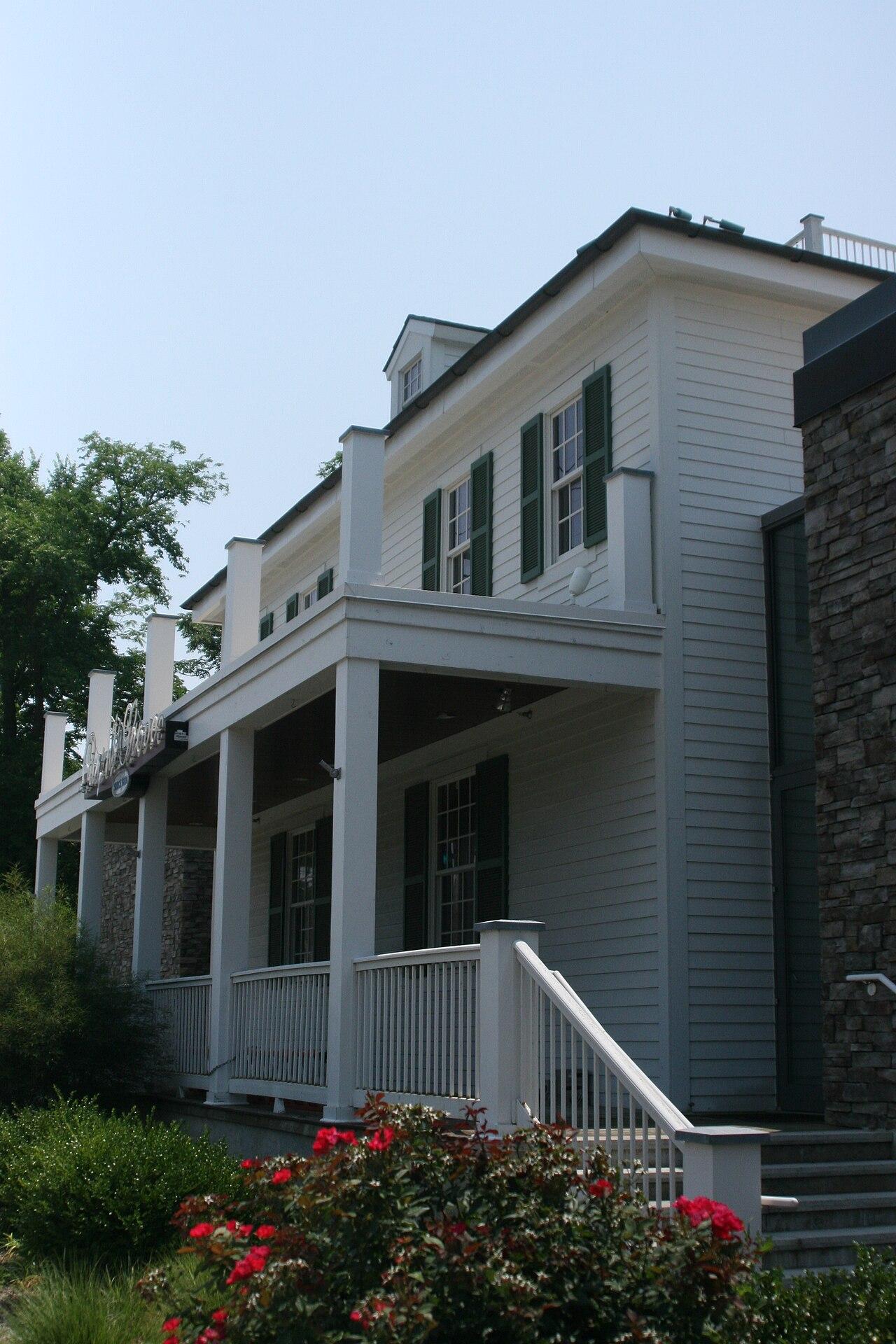
Miller sold the building in July 2008 to the developer Charles Cella, who leased it for an upscale grocery, the Market at Busch's Grove. It opened in December 2008 and closed on January 8, 2011, putting about 40 people out of work. Several restaurant plans followed and fell away. In 2016 PALM Health, an integrative medicine and wellness centre, opened in the old Busch's Grove building on Clayton Road.
Sources
- Busch's Grove, Lost Tables
- Lost Tables: The story of Busch's Grove, St. Louis Jewish Light
- Famous in its day: Busch's Grove, Restaurant-ing Through History (Jan Whitaker), November 30, 2010
- What would you do with the defunct Busch's Grove?, Ladue-Frontenac Patch, January 2011
- Busch's Grove in Ladue will reincarnate as a locally owned restaurant, Ladue-Frontenac Patch, July 12, 2011
- PALM Health, St. Louis' new healthcare oasis, opens in Ladue, St. Louis Magazine, April 27, 2016
From the regulars
Were you there? Be the first to add a memory of Busch's Grove.
Share a memory of Busch's Grove
The gift shop
The Busch's Grove sign on a tee, hoodie and more. All Busch's Grove pieces